Hilo3d API - v2.0.0-alpha.8

A modern Web graphics engine for production 2D and 3D experiences.
A portable RHI, validated Render Graph, and Scriptable Render Pipeline
power one shared renderer for WebGPU and WebGL 2.
Website · Examples · Documentation · API · 简体中文



Hilo3D 2.0 is currently in alpha. Existing projects should review the breaking changes before upgrading. Repository and website documentation may include Unreleased APIs; match version boundaries to the installed package.
Why Hilo3D
Hilo3D keeps high-level scene authoring and low-level GPU control in the same engine. Applications use one scene, material, render-target, and shader contract while the renderer selects a native WebGPU path or a production WebGL 2 compatibility path.
- One renderer, two backends —
autoprefers compatible WebGPU and uses WebGL 2 when WebGPU is unavailable. Explicit backend requests never change silently. - Modern materials and output — glTF 2.0, layered PBR, HDR lighting, Bloom, automatic exposure, filmic tone mapping, transmission, volume, iridescence, clearcoat, and anisotropy.
- 2D and 3D together — scene graph, meshes, animation, cameras, lights, shadows, sprites, text, batching, picking, and layered multi-camera composition.
- GPU-driven rendering — instancing and multi-pass rendering across both backends, plus a WebGPU high-end profile with GPU Scene culling/LOD, Hi-Z, indirect buckets, and Clustered Forward+.
- Stable high-end lighting — TAA/TAAU, dynamic resolution, GTAO, SSR, SSGI, froxel volumetrics, physical atmosphere, temporal clouds, cloud shadows, and eye adaptation.
- A frame you can shape — a validated Render Graph and scriptable render pipeline coordinate shadows, scene passes, post-processing, render targets, readback, and presentation.
- Production lifecycle — bounded GPU caches, incremental uploads, explicit resource ownership, and recovery from WebGPU device loss or WebGL context loss.
Install
npm install --save-exact hilo3d@next
next selects the 2.0 prerelease; --save-exact pins the resolved version. The unqualified
latest channel may still select 1.x. Match optional addon versions to the installed core. See
version boundaries and the
complete quickstart.
Hilo3D is ESM-only. It targets modern browsers with WebGPU or WebGL 2; WebGL 1 and legacy global builds are outside the 2.0 contract.
Build games with Codex
The standalone
hilo3d-game Agent Skill helps
Codex plan, scaffold, implement, debug, and optimize Hilo3D 2D, 3D, and hybrid browser games. It
uses the published hilo3d package and is kept outside .agents/skills so it is distributed from
this repository without becoming guidance for contributors working on the engine itself.
Create your first scene
import * as Hilo3d from 'hilo3d';
const camera = new Hilo3d.PerspectiveCamera({
aspect: innerWidth / innerHeight,
z: 4
});
const stage = await Hilo3d.Stage.create({
backend: 'auto',
container: document.querySelector('#app')!,
camera,
width: innerWidth,
height: innerHeight
});
new Hilo3d.Mesh({
geometry: new Hilo3d.BoxGeometry(),
material: new Hilo3d.PBRMaterial({
baseColor: new Hilo3d.Color(0.83, 0.12, 0.09),
metallic: 0.1,
roughness: 0.6
})
}).addTo(stage);
stage.addChild(new Hilo3d.AmbientLight({ amount: 1 }));
stage.addChild(
new Hilo3d.DirectionalLight({
amount: 3,
direction: new Hilo3d.Vector3(-1, -1, -1)
})
);
const ticker = new Hilo3d.Ticker(60);
ticker.addTick(stage);
ticker.start();
Stage.create() is asynchronous because backend selection and GPU initialization are asynchronous.
Use backend: 'webgpu' or backend: 'webgl2' when an application requires a specific backend.
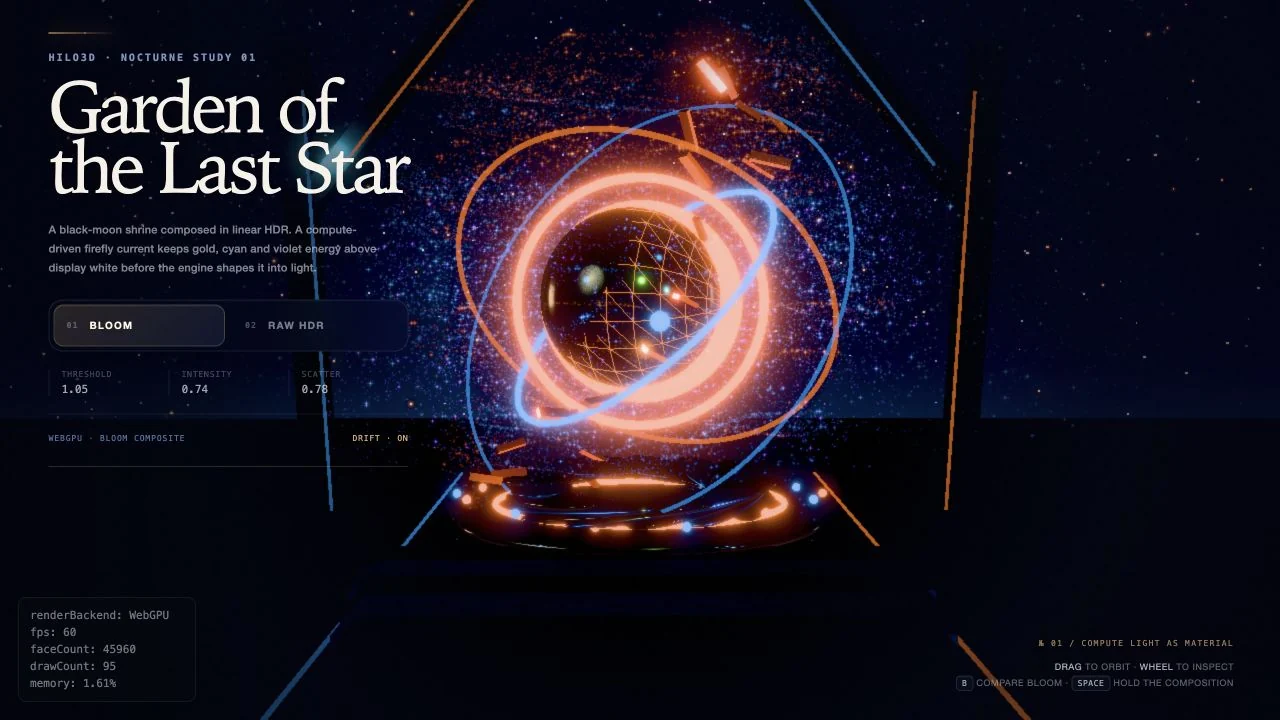
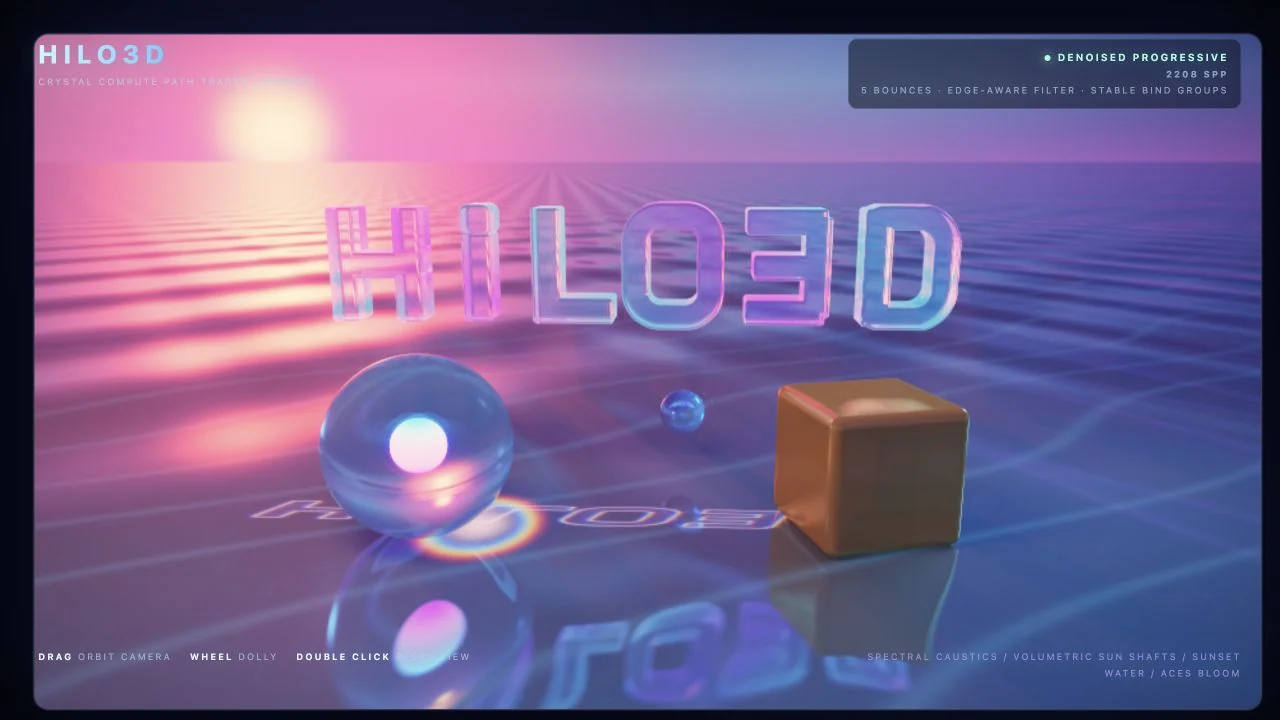
See the engine in motion
 |
 |
 |
| HDR Bloom Compute-driven light shaped through the engine post-processing pipeline. |
glTF material extensions Layered Khronos assets on the shared WebGPU and WebGL 2 renderer. |
Compute path tracing Progressive WebGPU tracing with denoising, caustics, and HDR output. |
Browse the complete example gallery →
Modern rendering stack
The opt-in WebGPU high-end profile is built on the same Scene, Material, Render Graph, and RHI contracts as the portable renderer. Unsupported devices fail capability checks before the runtime is created; compatible meshes that are outside the native GPU Scene slice remain on the shared Forward path and compose into the same linear HDR frame.
| System | Current production slice |
|---|---|
| GPU Scene | Dirty object/material databases, previous-frame Hi-Z occlusion, projected-radius LOD, compact visible ranges, and fixed indirect buckets |
| Clustered Forward+ | Depth-driven 3D clusters, bounded deterministic light allocation, storage PBR, shared directional/spot/point shadows, and LTC area lights |
| Shadow caching | Stable atlas tiles, exact per-slice invalidation, scissored depth clears, transactional reuse, and recovery-aware diagnostics |
| Temporal rendering | Motion vectors, authored reactive masks, native TAA, 0.5–1.0 TAAU, and timestamp-driven dynamic resolution |
| Screen-space lighting | Portable GTAO and SSGI on WebGPU/WebGL 2, plus WebGPU Clustered hierarchical SSR |
| Volumetrics and weather | Froxel height/local fog, directional/point/spot injection, physical atmosphere LUTs, temporal clouds, and cloud shadows |
| HDR display | GPU histogram exposure, asymmetric eye adaptation, Bloom, and configurable filmic display transforms |
Explore the Clustered Sponza lab, Temporal Observatory, Silent Dragon GTAO, Afterimage SSR, Prismatic Vespers SSGI, Neon Reliquary volumetrics, and Stormfront Observatory.
See the modern WebGPU rendering roadmap for the exact completed boundaries, remaining compatibility paths, and future streaming/virtualization work.
Rendering profiles
| Portable profile | WebGPU high-end profile | |
|---|---|---|
| Backend | WebGPU and WebGL 2 | WebGPU |
| Scene and materials | Shared scene graph, PBR materials, glTF, sprites, text | The same public model with registered PBR buckets and Forward fallback |
| Frame composition | Render Graph, render targets, MRT, MSAA, post-processing | The same graph with GPU Scene, clustered lighting, and native compute |
| Lighting and quality | Forward PBR, shadows, GTAO, SSGI, TAA/TAAU, Bloom, Color Uber | Adds Hi-Z SSR, dynamic resolution, froxels, atmosphere/clouds, auto exposure |
| GPU workloads | Instancing, uniform buffers, incremental resource uploads | Compute, storage buffers/textures, indirect GPU workflows |
| Shader path | Authored GLSL ES 3.00 | Raster GLSL → Naga → WGSL; validated direct WGSL compute |
| Recovery | WebGL context restoration or WebGPU resource rebuild | WebGPU device reacquisition with submission-aware history rebuild |
Unsupported WebGPU-only features fail capability checks on WebGL 2 instead of being partially emulated.
Architecture at a glance
Scene · Materials · 2D · Animation · Lights
│
Shared Renderer
│
Render Graph · Scriptable Render Pipeline
│
Portable RHI
┌─────┴─────┐
WebGPU WebGL 2
The shared renderer owns scene collection, culling, sorting, instancing, shadows, post-processing, draw preparation, and resource coordination. Production frames flow through the Render Graph and portable RHI; backend code remains responsible only for native API execution.
Raster shaders have one GLSL ES 3.00 source of truth. WebGL 2 compiles that source directly, while
the WebGPU path preprocesses it for Naga and produces WGSL. WebGPU-only compute uses the engine's
validated ComputeShader contract.
Read the rendering architecture for the complete frame, resource, shader, and recovery contracts.
Documentation
Develop locally
Requires Node.js 20.19.0 or newer and the npm version declared by the repository.
npm ci
npm run dev
Useful commands:
npm run examples:dev # run the example gallery locally
npm run typecheck # check maintained TypeScript
npm run test # run the test suite
npm run validate # run the full release validation
See the contributing guide before opening a pull request.
License
MIT © Hilo3D contributors.